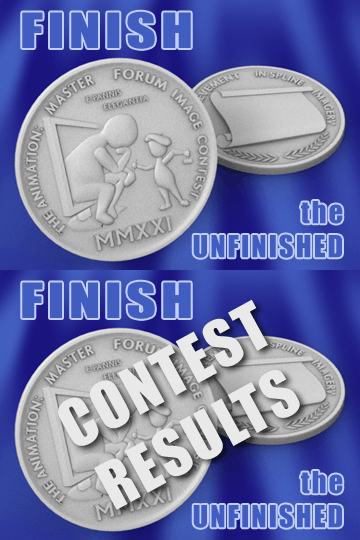
Hash Fellow robcat2075 Posted September 22, 2023 Hash Fellow Posted September 22, 2023 The long overdue Prehistoric contest medal is taking shape... 1 Quote
Hash Fellow robcat2075 Posted August 27 Author Hash Fellow Posted August 27 I'm learning to 3D print now. Here is the front face of the medal fresh out of the resin printer. It is printed at an angle to reduce layer lines. Now dried and cured. Printing supports not removed yet. Some will snap off, others have to be snipped off. Medal face. I'm trying to judge if anything needs to be made more prominent to survive the casting process. All of the detail has to fit in the 1mm between the floor and the rim of the "dish". CU of Thom and his paint brush. Layer lines are just barely apparent. They are more like random noise. 1 1 Quote
*A:M User* Roger Posted August 28 *A:M User* Posted August 28 Wow! Looking really good! How long did the print take? Quote
Hash Fellow robcat2075 Posted August 28 Author Hash Fellow Posted August 28 5 hours ago, Roger said: Wow! Looking really good! How long did the print take? Thanks! Two hours and 4 minutes. Quote
Hash Fellow robcat2075 Posted August 28 Author Hash Fellow Posted August 28 Here is WIP on the "Thom the Thinker" for "Finish the Unfinished" Early version: Redo after more study of the original: Thom is changed to a sculptor: Splined: Test print: Quote
fae_alba Posted August 31 Posted August 31 very very nice. Makes me sort of want to do another contest! Quote
Hash Fellow robcat2075 Posted September 9 Author Hash Fellow Posted September 9 The medal was designed to be 2.5 inches but my new digital calipers reveal it to be a mere 2.47 inches. Quote
Hash Fellow robcat2075 Posted September 27 Author Hash Fellow Posted September 27 The current plan... I'll print out these forms which contain positives of the medal face and reverse. Then I fill those with Plaster of Paris to make the molds. the pegs modeled into the forms should make the plaster halves fit together... exactly. 1 Quote
Hash Fellow robcat2075 Posted October 2 Author Hash Fellow Posted October 2 I 3D printed these tiny molds to test out the Plaster of Paris idea... It mostly works. I used Vaseline to coat the sides but it was too stiff and prevented the plaster from reaching every corner... Plaster of Paris can match even very small details, this is from the bottom of the cup I mixed the plaster in, but getting all the bubbles out is a problem. Here is a full print of the medal face and the plaster impression. This time I used soapy water to coat the plastic. Notice the bottom edge of the print is curved. That is not a lens distortion, it should be straight but warped somehow in printing. Getting a truly flat surface or straight line in these 3D prints is difficult, but i will need to have that for this to work. The nooks and crannies of the text are the least successful. It's possible i just need to let the plaster dry longer. Quote
Hash Fellow robcat2075 Posted October 5 Author Hash Fellow Posted October 5 This hi-temperature silicone material looks ideal but the need for a precision scale to measure it and a vacuum chamber to de-bubble the mixture is a problem. Quote
Hash Fellow robcat2075 Posted October 7 Author Hash Fellow Posted October 7 Melting pewter in a tiny frying pan... poured in the plaster mold... This first test looks pretty cheap and awful... The pewter doesn't want to fill all the details... Quote
*A:M User* Roger Posted October 7 *A:M User* Posted October 7 Not bad for a first try, though. Maybe you need to add something to the pewter to get it to flow better? Quote
Ganthofer Posted October 7 Posted October 7 The following are from someone who hasn't done/seen any metal casting since high school shop class (+45 years ago). Suggestions (if you haven't already tried these): warm the mold (a cold mold can cause the molten metal to skin over on contact preventing it from flowing into the small details) Use Jeweler's Talc (very fine without impurities/additives - no asbestos) very lightly brushed on the mold surface (helps the molten metal flow - reduces surface tension) brush aside the surface scum on the molten metal Also, since your half mold is shallow, you have the added disadvantage of less weight (molten metal) pushing it in to the mold details and displacing the air. Quote
Hash Fellow robcat2075 Posted October 7 Author Hash Fellow Posted October 7 9 hours ago, Ganthofer said: The following are from someone who hasn't done/seen any metal casting since high school shop class (+45 years ago). We had shop class ("Industrial Arts") but unfortunately, no metal casting! These are good suggestions... Quote warm the mold (a cold mold can cause the molten metal to skin over on contact preventing it from flowing into the small details) I heated the mold to 350° beforehand. Since the plaster survived that I'll try hotter next time. Quote Use Jeweler's Talc (very fine without impurities/additives - no asbestos) very lightly brushed on the mold surface (helps the molten metal flow - reduces surface tension) I had read to use powdered graphite as a "release" to keep the mold from sticking to the pewter. The pewter did fall right out of the mold after it cooled but I wonder if graphite has the same surface tension benefit as the talc? Quote brush aside the surface scum on the molten metal I should do that. Quote Also, since your half mold is shallow, you have the added disadvantage of less weight (molten metal) pushing it in to the mold details and displacing the air. The final version of the mold will have both halves clam-shelled together with the medal shape on edge. Hopefully that will be "deeper" than lying flat. Quote
Hash Fellow robcat2075 Posted October 9 Author Hash Fellow Posted October 9 New problem.... 1 The text and other decorations are modeled straight 2 Distortion boxes are used in the Chor to fit those to the curve of the medal 3 To bake-in those curves, a new MDL is exported from the Chor, but the laurel leaves get corrupted. It worked before, now it doesn't. I'll need to try an earlier version. Quote
Hash Fellow robcat2075 Posted October 10 Author Hash Fellow Posted October 10 The new version has dual vents at the top and separately-printed snap-on side rails to contain the plaster when it is poured on. the medal reverse will be printed separately and glued to the underside, hopefully accurately positioned bya tiny guide ring I have added. 1 1 Quote
Hash Fellow robcat2075 Posted October 11 Author Hash Fellow Posted October 11 10 printing hours later... Quote
Hash Fellow robcat2075 Posted October 26 Author Hash Fellow Posted October 26 A test pour in a two-sided plaster cast... The detail is quite sharp in the lowest region of the mold... But less sharp and noisier near the top... The dinosaur face is particularly messy... 1 1 Quote
Ganthofer Posted October 27 Posted October 27 Much improved! My thoughts on the top being less sharp/noisy could be due to a decrease in weight pushing down (less material above) or the molten metal cooling slightly as it comes to the end of the pour. Quote
Hash Fellow robcat2075 Posted November 2 Author Hash Fellow Posted November 2 Whoops! The mold leaked! I guess i need to the traditional "delft clay" a try. Plaster of Paris is very detailed but it takes too long to harden, too long to know if i have a good impression, and it's hard to get the two halves exactly fitting each other. 1 Quote
Hash Fellow robcat2075 Posted November 2 Author Hash Fellow Posted November 2 Delft clay casting requires a frame to contain the clay but most are just a few inches across, for casting objects like buttons or rings.. On the premise that a deep mold will get a more detailed cast I've made frame that is 8 inches high. 1 Quote
Hash Fellow robcat2075 Posted November 3 Author Hash Fellow Posted November 3 A 3D photo before it gets melted back down. Cross your eyes to merge the left and middle image to see 3D. The middle and right image are for people who prefer to "parallel view". 1 Quote
Hash Fellow robcat2075 Posted November 16 Author Hash Fellow Posted November 16 I'm waiting for my delft clay to arrive. Here is another attempt with plaster. Although this had taller spouts to provide a deeper mold the overall result is poor. Once again the bottom has sharp detail. Notice that even the circular layer lines of the 3D print are still visible... The top, however is quite lacking... Quote
Ganthofer Posted November 16 Posted November 16 Hmm. The top third looks much worse than the previous test in the post from October 26th. Warmed and dusted (talc or graphite) the mold? I hope it flows in the deft clay better. Quote
Hash Fellow robcat2075 Posted November 17 Author Hash Fellow Posted November 17 In the above attempt I dusted the mold with graphite dust but did not pre-heat it. For this one I preheated it to 425°F but at that temp there is nothing to stop the pewter from leaking through the tiniest crevices. I put some lithium grease around the edge but that did not seal it. the part of the medal that did get cast has weak detail again. I tried to spoon out the slag before I poured but it seems like there is an infinite amount bubbling up to the top. You can never scoop it all out. (you may have to download this to see it. MAH01933.MP4 Quote
Ganthofer Posted November 17 Posted November 17 It almost looks like it's boiling. Some kind of crystals constantly forming. Could be the Oxidation process mentioned below The possible causes I could find are: Keep the temperature stable: If the molten pewter turns gold, purple, or white, it's too hot. A stable temperature is crucial for preventing excessive oxidation, which leads to more slag. Use a flux: Add a small amount of beeswax to the surface to prevent oxidation, which will help impurities form a distinct layer on top. Quote
Hash Fellow robcat2075 Posted November 18 Author Hash Fellow Posted November 18 I'm afraid the only temperature control I have is ON or OFF. I guess I need to pour it the instant the pewter has melted. I suppose I thought that if I got it as hot as possible it would flow more freely into the mold. Quote
Ganthofer Posted November 18 Posted November 18 The beeswax might help to keep it from oxidizing (if that is what we are seeing) at the surface. Is the molten pewter tinted (e.g. no longer silver in color) as mentioned in the "Keep the Temperature stable:" above? Does the melting pot give any specs on it max temp? I see the melting pots 500Watt rating in one of the photos. Did the pewter come with a data sheet or the composition of it (e.g. %tin, %antimony, %copper - assuming leadfree pewter?) to research the appropriate temperature range that should be used? Then of course, finding a thermometer with a suitable range to check the temp. If it is too hot, it should be possible to add a thermal cutoff (sensor) to the melting pot. I modified a small crockpot in this manner to maintain a temp in the required 140-150 degrees F. As an alternative, a Dimmer switch rated for a 600Watt incandescent light bulb should make it possible to reduce the temperature. This of course requires a thermometer and time to adjust the dimmer then wait for the temp to stabilize and measure, repeat .... until it's at desired temp. Just throwing out some ideas. Quote
Hash Fellow robcat2075 Posted November 18 Author Hash Fellow Posted November 18 The pewter was this item Casting Pewter Alloy(98% Tin-15oz), Low Melting Point Metal 338-446°F, Jewelry Crafting, Sculpture and Artistic Project, Option in Hemisphere/Ingot, Professional Metal for Artisan Craft & DIY Item It looked nice and shiny in the picture! Heating the mold to 425° was probably overkill 16 hours ago, Ganthofer said: Is the molten pewter tinted (e.g. no longer silver in color) as mentioned in the "Keep the Temperature stable:" above? The slag had a slight yellow tinge but the molten metal looked silvery. Quote Does the melting pot give any specs on it max temp? I see the melting pots 500Watt rating in one of the photos. I bought the cheapest crucible I could buy. I notice now ... it's not UL listed! It says it can melt lead which is about 620°F, much hotter than I need for pewter. I should pour as soon as the ingots have collapsed. 1 Quote
Hash Fellow robcat2075 Posted November 20 Author Hash Fellow Posted November 20 Here is yet another attempt: Scouring with a 3M Scotchbrite® pad cleaned it up a bit... 1 Quote
Ganthofer Posted November 21 Posted November 21 Definitely making progress. The delft clay should be interesting. Using the plaster of paris mold, If you make another 3D print, invert it. Pour hole from the other edge of the medal, just to verify that whatever is at the bottom is coming out sharper. How smooth is the 3D resin printed surface? What kind of small defects are there? From the early photos at the top, it looks like there are fine lines. Also, the surface may have micro bubble which makes it somewhat like being porous. The plaster of paris will adhere to it slightly. You might try sealing the 3D resin print with some sort of spray paint/sealer. Polyurethane, a two-part epoxy, or a specialized acrylic spray. Obviously, it needs to be very thin coat, or it will also smooth out the details. Another thought popped into my mind. Making the details deeper, so that sealing the 3D resin print can smooth/seal everything and not make the resulting details to small. Making the 3D resin print with the expectation that the paint/sealer will add a certain amount of thickness to everything. If you seal the 3D resin object, then Silicone spray (which is thin as water) might work as a release agent for the plaster of paris mold. Likewise, it might be possible to find some sort of High temp sealer that could be applied to the fully cured plaster of paris mold to fill the micro bubbles, etc. If pressure/weight is what is making the bottoms of the coin sharper, then there are few other possibilities to increase the pressure: make the Fill spout bigger/taller Centrifugal force - somehow spinning the mold so there is more apparent weight. Pouring while it's spinning is probably not possible without a very complicated setup. but spinning immediately after pouring may help. Depends on if the pewter has already solidified too much, or if it's still somewhat fluid inside. linear Acceleration - fill the mold, then launch/push the mold in the direction of the fill hole spout. Of course, timing would be a bit critical. The reason above (still fluid) and the upward acceleration would have to continue until the pewter solidified of the deceleration could just cause the problem else ware due to where the weight/pressure shifted to. Don't mind me, it's just the theoretical mad scientist throwing things at the wall to see if anything sticks 🤪 Quote
Hash Fellow robcat2075 Posted November 21 Author Hash Fellow Posted November 21 11 hours ago, Ganthofer said: How smooth is the 3D resin printed surface? data:image/gif;base64,R0lGODlhAQABAPABAP///wAAACH5BAEKAAAALAAAAAABAAEAAAICRAEAOw== To the naked eye it appear exceedingly smooth but not shiny. The layer lines can only be seen on VERY close inspection with a magnifier. Quote What kind of small defects are there? From the early photos at the top, it looks like there are fine lines. Also, the surface may have micro bubble which makes it somewhat like being porous. The plaster of paris will adhere to it slightly. You might try sealing the 3D resin print with some sort of spray paint/sealer. Polyurethane, a two-part epoxy, or a specialized acrylic spray. Obviously, it needs to be very thin coat, or it will also smooth out the details. My problem is getting such a thing absolutely evenly applied and so it is not collecting into crevices. Quote If pressure/weight is what is making the bottoms of the coin sharper, then there are few other possibilities to increase the pressure: make the Fill spout bigger/taller For plaster I would need to make a two-part 3D master rint as 6 inches is about the top-to-bottom limit for one printed piece. It's possible. My delft clay frame is already taller since the spout holes are carved post-impression and don't need to be part of the 3D print as for plaster. Quote Centrifugal force - somehow spinning the mold so there is more apparent weight. Pouring while it's spinning is probably not possible without a very complicated setup. but spinning immediately after pouring may help. Depends on if the pewter has already solidified too much, or if it's still somewhat fluid inside. linear Acceleration - fill the mold, then launch/push the mold in the direction of the fill hole spout. Of course, timing would be a bit critical. The reason above (still fluid) and the upward acceleration would have to continue until the pewter solidified of the deceleration could just cause the problem else ware due to where the weight/pressure shifted to. These are less likely. Spinning a bucket of molten pewter around the kitchen seems awkward. Here is another go with plaster... Quote
Hash Fellow robcat2075 Posted yesterday at 07:32 PM Author Hash Fellow Posted yesterday at 07:32 PM The first attempt with Delft clay. The basic process is to fill the bottom half of the frame (on right) with clay, pound it flat, add the 3D print. Next, other half of the frame (on left) is placed and more clay is added and pounded flat to force an impression of the 3D print. The two halves are pulled apart to remove the 3D print and reveal the negative void it leaves behind. Unfortunately, all the pounding broke the 3D print. The clay has to be pounded very tightly to get a good impression and so that the two sides retain their shape when they are pulled apart. The "Clay" is really more like clumpy sand. I cast it anyway to see what would result. Here are the two sides put back together waiting for the pewter to melt and be poured into the top hole. And... it leaked! CU of the cast... Quote








Recommended Posts
Join the conversation
You can post now and register later. If you have an account, sign in now to post with your account.
Note: Your post will require moderator approval before it will be visible.